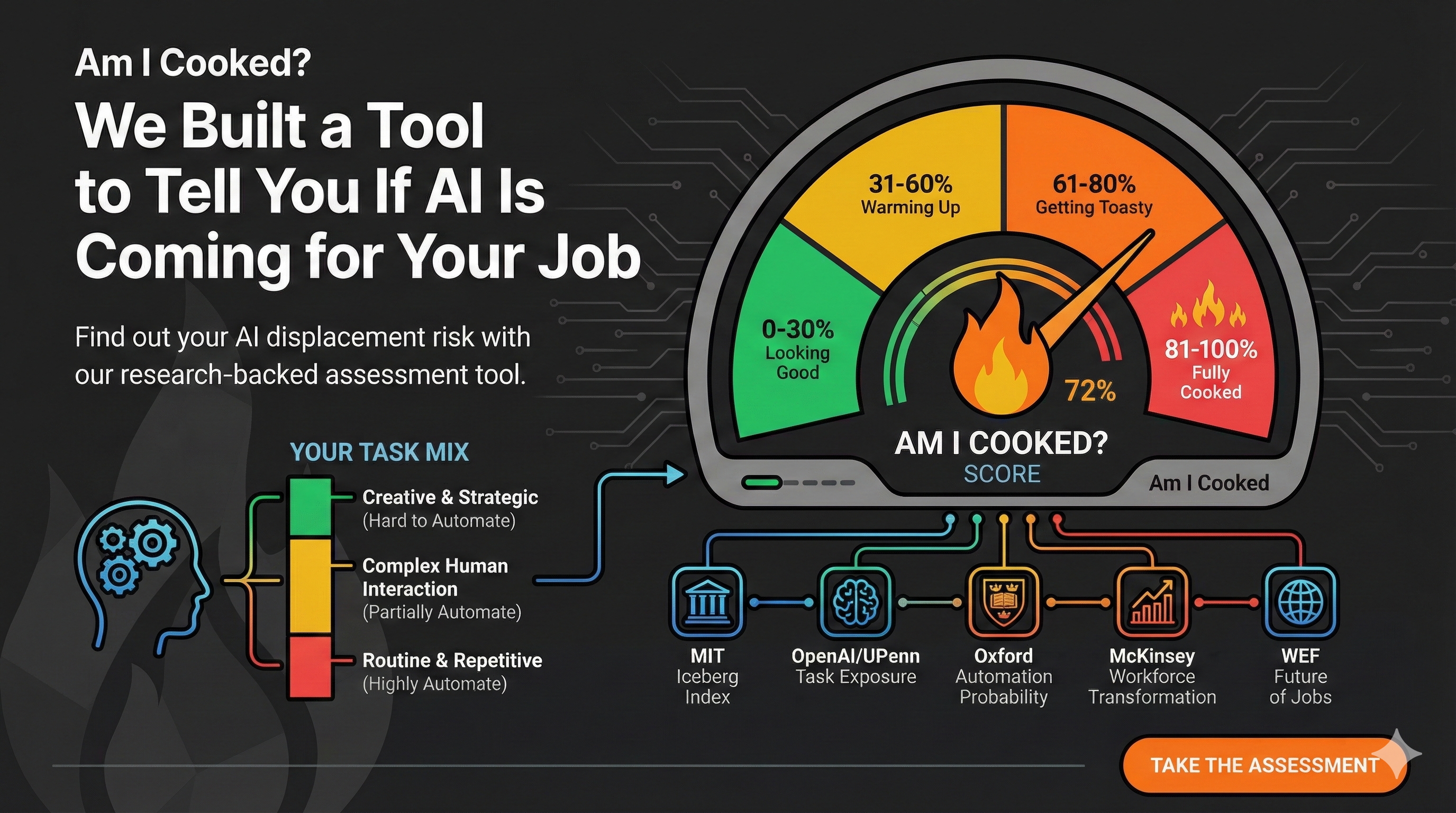
Everyone's asking the same question: "Is AI going to take my job?"
The honest answer? It depends. And not in the vague, hand-wavy way you've been hearing from think pieces.
Most answers online fall into three useless buckets:
- Doom ("everyone is cooked")
- Denial ("nothing will change")
- Vibes ("just be more creative")
We built Am I Cooked because the truth is more specific—and more useful:
Your risk depends on your tasks, your industry's adoption speed, and how much of your week is made of work AI is getting good at.
This is a 90-second assessment that gives you a score and, more importantly, what's driving it.
What the score is (and isn't)
It is:
- A task-level estimate of how exposed your day-to-day work is to AI capabilities
- Adjusted for the reality that adoption varies wildly by industry (regulation, liability, integration costs)
- Backed by research from MIT, OpenAI/UPenn, Oxford, McKinsey, and the World Economic Forum
It is not:
- A prediction that you'll be unemployed next month
- A judgment of your value or potential
- A "top 10 AI-proof jobs" list (those are usually wrong within 2 years)
Think of it like a weather forecast: if the chance of rain is high, you don't panic—you bring an umbrella.
Why job titles are misleading
Two people with the same title can have opposite outcomes because they do different work.
A "Customer Support Rep" might spend the week:
- Handling escalations, negotiating refunds, calming angry customers, coordinating across teams (lower exposure), or
- Answering repetitive questions from a script and triaging routine tickets (higher exposure)
Same title. Different task mix. Different risk.
This is exactly what OpenAI/UPenn found in their task exposure research: ~80% of workers have at least 10% of their tasks exposed to LLMs. But ~19% have 50%+ of tasks exposed. The distribution is wildly uneven—even within the same job category.
The three forces that determine your risk
1) Capability — Can AI do the task?
2) Adoption — Will organizations actually deploy it? How fast?
3) Task mix — How much of your week is made of those tasks?
Most AI takes focus on (1) alone. Real life is (1) × (2) × (3).
That's why the "radiologists are doomed" prediction from 2016 still hasn't materialized. AI can technically identify tumors. But healthcare systems need regulatory approval, liability frameworks, workflow integration, physician buy-in, and patient acceptance. Each layer adds years.
If you want the best explanation of (2), read our breakdown of the Iceberg Index: What MIT's Iceberg Index Actually Means for Your Career
What your score actually means
0–25% — Rare (Looking Good) Your task mix includes work AI currently struggles with: complex judgment, physical dexterity, relationship building, novel problem-solving. Protect your moat. Learn AI tools to increase output, not because you're threatened.
26–50% — Medium (Warming Up) Significant portions of your work could be augmented or replaced in the next 3-5 years. Identify your 2-3 most exposed tasks and start shifting toward higher-trust, higher-judgment work.
51–75% — Well Done (Getting Toasty) Your role has high AI exposure. The good news: you likely have transferable skills. You don't need to reinvent your career—you need a task-mix pivot and a runway plan. Start now.
76–100% — Burnt (Fully Cooked) Most of your daily tasks are in AI's crosshairs. This isn't a death sentence—it's a signal to act immediately. Upskilling or role-shifting today is dramatically easier than doing it reactively in 18 months.
If you score high, start here: You Scored 70%+ Cooked. Now What?
The research behind your score
We didn't invent a number. We synthesized:
- MIT's Iceberg Index — The gap between AI capability and actual workplace adoption
- OpenAI/UPenn's "GPTs are GPTs" — Task-level exposure analysis across 1,000+ occupations
- Frey & Osborne (Oxford) — The foundational automation probability research
- McKinsey's Workforce Reports — Enterprise adoption patterns (entry-level faces 14x higher transition risk)
- WEF Future of Jobs 2025 — 170M jobs created, 92M displaced globally
Full methodology is on the site for anyone who wants to dig into the sources.
Try it (and share your score)
- Take the 90-second assessment
- Share your score (misery loves company, and so does career anxiety)
- If you want meaningful feedback, include: your role + the top 3 tasks you do each week
We'll keep publishing role-specific breakdowns and action plans. Next up: analysts, marketers, SDRs, PMs.