The Number Nobody's Talking About
Everyone's focused on how many jobs AI will take. That's the wrong question.
MIT says 11.7% of the workforce is technically replaceable today. McKinsey projects 12 million Americans will need to change occupations by 2030. The WEF estimates 92 million jobs displaced globally.
These numbers are scary. They're also missing the point.
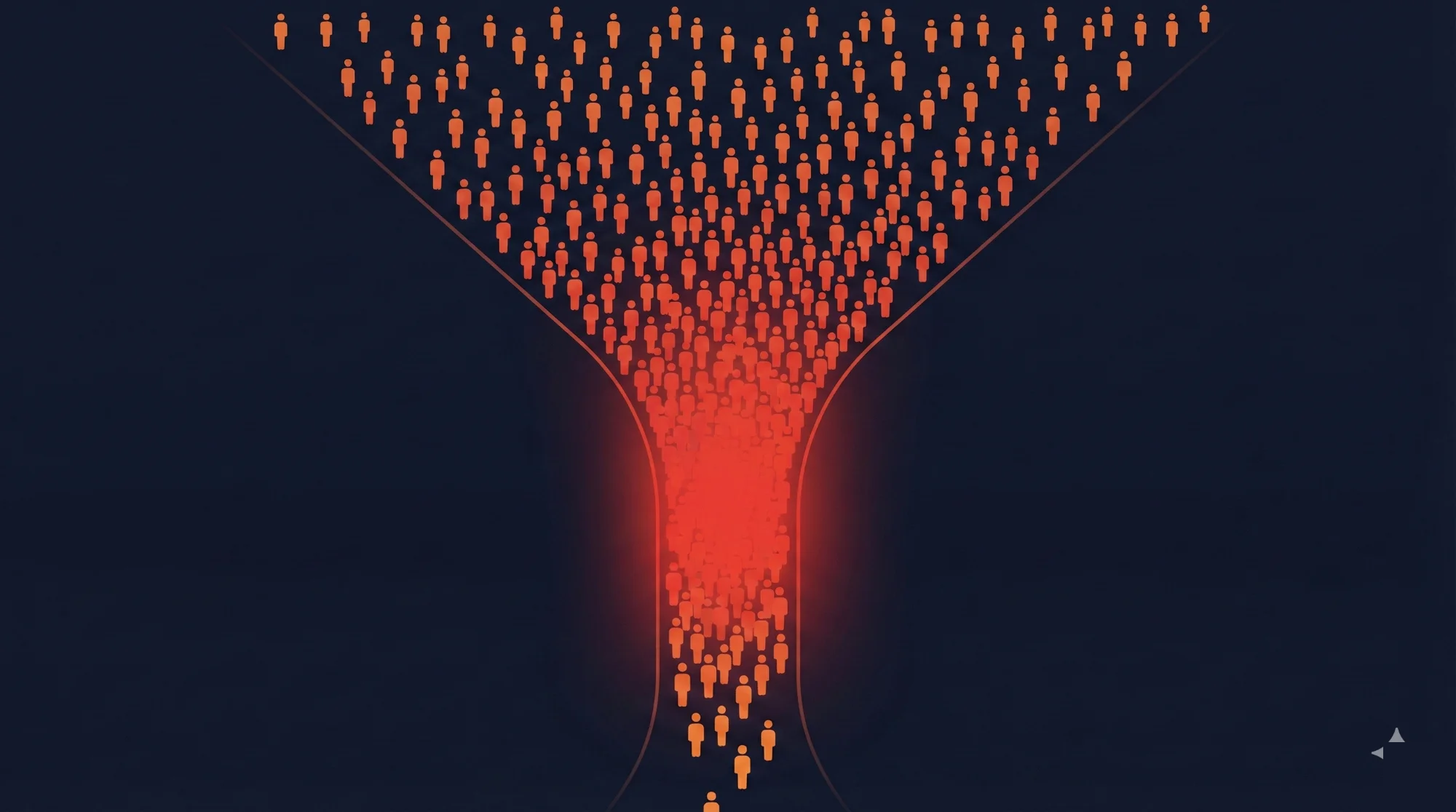
The real problem isn't displacement. It's the queue.
Here's what happens in a normal economy: You lose your job. You look for a new one. Median time to find work? About 9 weeks. Uncomfortable, but survivable.
Now imagine 20% of the workforce gets displaced over 5 years. That's not 20% unemployment—people find new jobs, the economy adapts. But here's the math nobody's doing:
When 10 million people are looking for work at the same time, the 9-week job search becomes a 40-week job search.
It's not linear. The labor market has finite absorption capacity—there are only so many openings, so many interviews companies can conduct, so many positions to fill each month. When displaced workers exceed that capacity, everyone waits longer. And the wait times compound.
During the 2008 recession, unemployment hit 10%. Median job search time doubled to 21 weeks. In some states during COVID, it spiked to 30 weeks.
Now imagine something faster and more concentrated than either of those.
We built a tool to visualize this
AI Displacement Outlook lets you explore different scenarios:
- Adjust the displacement rate: What if it's 15%? 25%?
- Adjust the timeline: What if it happens over 3 years instead of 10?
- See your state: Some regions are more exposed than others
The sliders aren't there to scare you. They're there to help you understand the non-linear dynamics that most coverage ignores.
When you move the displacement rate from 10% to 20%, watch the expected job search duration. It doesn't double. It triples. That's the bottleneck effect.
What the research actually says
We built this on real data:
-
MIT Iceberg Index (2025): Maps AI technical exposure across 151 million workers, 923 occupations, and 3,000 counties. The 11.7% figure isn't speculation—it's calculated from skill-by-skill analysis of what current AI systems can actually do.
-
BLS JOLTS data: Current job openings (~7.7 million), monthly hires (~5.5 million). These are the constraints that create the bottleneck.
-
BLS unemployment duration data: Historical calibration showing how search times increase during high-unemployment periods.
The state-level exposure scores combine MIT's published values with estimates based on industry concentration patterns. We're transparent about what's directly from research versus what we've interpolated. See our methodology.
This isn't fear-mongering
We're not trying to terrify you. We're trying to help you see something that's hard to see: the second-order effects of mass displacement.
The headlines focus on which jobs AI will take. The policy debates focus on whether it will happen. Almost nobody is modeling what it looks like when it does—the cascading effects on job markets, regional economies, individual career timelines.
That's what the Outlook tool is for. Not prediction. Scenario exploration.
What to do with this information
If you're in a high-exposure role or industry, the takeaway isn't panic. It's lead time.
The bottleneck model shows that when you start looking matters almost as much as what you're looking for. In a saturated market, the people who move first have a structural advantage. The people who wait until their job disappears are competing with everyone else who waited.
Take the full assessment to see your personal exposure. Then use the Outlook tool to understand what different scenarios mean for your timeline.
The goal isn't to predict the future. It's to prepare for it.
Am I Cooked combines research from MIT, OpenAI/UPenn, Oxford, McKinsey, and the World Economic Forum to assess AI career displacement risk. The Outlook tool is free to use at amicooked.co/outlook.