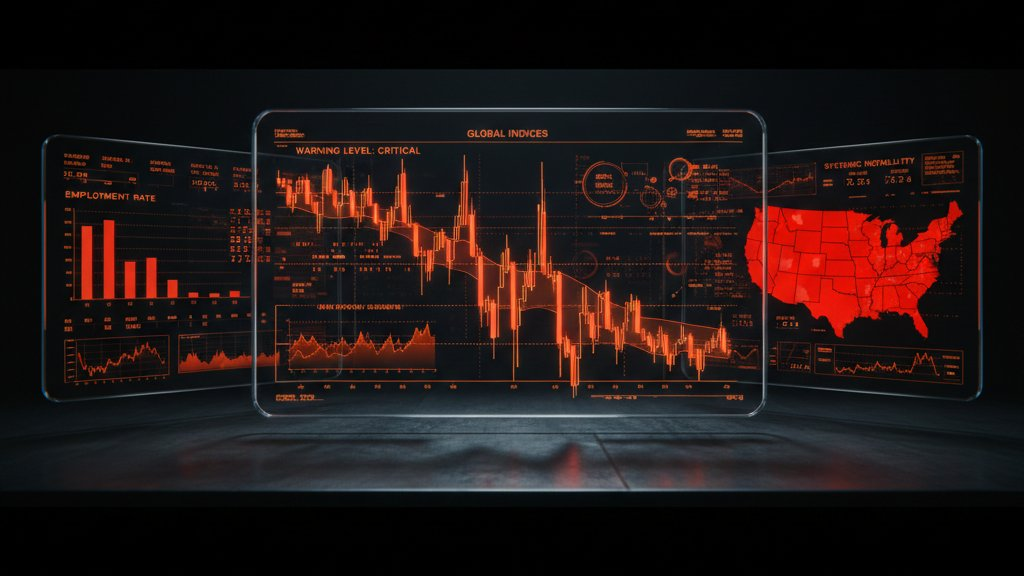
The Shift Is Here: Tracking the AI Workforce Transition in Real-Time
Published: February 2026
On February 3rd, 2026, software stocks lost $285 billion in market value in a single day. Salesforce, Workday, ServiceNow — the companies that defined the SaaS era — watched their valuations crater as investors suddenly realized what's been obvious to anyone paying attention: AI doesn't just augment these tools. It replaces the need for many of them entirely.
That was one day. One data point.
But it's part of a pattern. Entry-level hiring in AI-exposed roles is down 13%. Office vacancy just hit a national record at 19.6%. Tech layoffs in 2026 are already at 45,000+, with companies explicitly citing AI as the reason.
Am I Cooked tells you how cooked you are. But we kept getting asked: how cooked is everything?
That's what The Shift answers.
What Is The Shift?
The Shift is a new section of Am I Cooked that tracks the AI-driven workforce transition as it unfolds. Not predictions. Not vibes. Observable data, research-backed scenarios, and real-time indicators.
Six interconnected views:
Timeline — Three AGI scenarios (aggressive, moderate, conservative) with parallel tracks showing how displacement unfolds depending on when transformative AI arrives. Branch points show what decisions determine which path we're on.
US — State-by-state vulnerability projections. Which metros get hit first. How the economic cascade flows from white-collar layoffs through consumer spending to housing to regional stress.
Global — How different regions are responding. The US is in denial. The EU has regulation. Nordic countries have safety nets. Who's prepared and who isn't.
History — How does this compare to past transitions? The Industrial Revolution took 80 years. The Great Depression took a decade. The Rust Belt is still happening. AI moves faster and broader than any of them.
Indicators — The live dashboard. Layoff counts, market signals, CRE data, policy status, and CEO quotes. Updated as events occur. "What They Say vs. What They Do" tracks the gap between corporate PR and actual headcount decisions.
Horizon — What's on the other side if we navigate this successfully. Disease, poverty, scarcity — what becomes possible in 10-20 years. The upside is enormous. Getting there is the hard part.
Why Build This?
Because the information exists, but it's scattered. You'd need to follow BLS releases, track WARN filings, monitor layoff aggregators, read McKinsey reports, parse Fed research, and somehow synthesize it into a coherent picture.
We did that. The Shift puts it in one place.
More importantly: the narrative is wrong.
The dominant framing is still "AI will create more jobs than it destroys" and "this is just like every other technological transition." That framing comes from people whose jobs aren't on the line — executives, economists, policymakers who've never had to update a resume because a model can do their work cheaper.
The research tells a different story:
- McKinsey: Entry-level workers are up to 14x more likely to need occupation changes than senior roles
- Stanford Digital Economy Lab: Entry-level hiring in AI-exposed occupations down 13%
- MIT Iceberg Index: 11.7% of the US workforce is technically replaceable today, representing $1.2T in wages
- WEF Future of Jobs 2025: 40% of employers plan AI-driven workforce reduction
This isn't decades away. It's happening now. The Shift tracks it.
What We're Watching
The Indicators view includes signals across four categories:
Employment: Tech layoffs, AI-attributed cuts, entry-level job postings, recent grad unemployment
Markets: Software ETFs, SaaS valuations, the sectors getting repriced as investors realize AI changes unit economics
Real Estate: Office vacancy, CRE loan maturities, CMBS delinquency, foreclosure filings. Commercial real estate is the canary — when companies need fewer people, they need less space.
Policy: Federal UBI legislation (none), state pilots (3 active), AI regulation (minimal). The gap between what's happening and what policy is doing about it.
We also track CEO quotes. Not the PR statements — the candid ones:
"AI will replace literally half of all white-collar workers" — Jim Farley, Ford CEO
"AI could eliminate half of all entry-level white-collar jobs" — Dario Amodei, Anthropic CEO
When the people building the technology are saying this, maybe we should listen.
The Branch Points
The Timeline view isn't just "here's what happens." It's "here's what determines which path we're on."
We're currently in Phase 1: Denial & Acceleration. Mass layoffs framed as "efficiency." Record AI investment. Zero policy response.
The question is what comes next. Phase 2 (Peak Displacement) is approaching. The branch point: does policy respond?
Signals pointing toward Managed Transition:
- Federal UBI legislation introduced
- 5+ states with emergency programs
- Substantive AI regulation
- Displacement becomes a top-3 political issue
Signals pointing toward Instability:
- Policy vacuum continues
- Corporate resistance to regulation
- Regional economic divergence
- Political polarization on AI response
Right now? Instability is leading 2-0.
These aren't predictions. They're observable signals you can track. The Indicators view updates as they change.
The Horizon
The Shift is heavy. Five views of displacement, disruption, and economic pain.
But there's a reason this transition is happening: the upside is potentially the largest improvement in human welfare in history.
The Horizon shows what becomes possible:
- Disease: Most cancers manageable, neurodegenerative diseases preventable, aging itself potentially treatable
- Poverty: Post-scarcity for basic needs when AI optimizes production and distribution
- Climate: Finally having the tools to reverse emissions before tipping points
- Work: Shift from "labor for survival" to "contribution by choice"
These outcomes aren't guaranteed. They require solving AI alignment (making sure advanced AI actually does what we want). They require the benefits being distributed, not captured by a few.
The Shift is the painful part. The Horizon is why it's worth navigating.
How to Use It
If you haven't taken the assessment yet: Start with your personal score. Find out how cooked you are. Then explore The Shift to understand how your situation fits the macro picture.
If you've already got your score: The Shift adds context. Your 73% score means something different if we're heading toward Managed Transition vs. Prolonged Instability.
If you just want to track what's happening: Bookmark /shift/indicators. We update it as significant events occur. The February 3rd crash, Demis Hassabis at Davos, policy developments — it's all there.
What's Next
The Shift is live, but it's not done. Coming soon:
- Live status dashboard: A state machine showing exactly where we are in the transition and what triggers the next phase
- Automated indicator updates: Pulling from BLS, WARN filings, and market data automatically
- Email alerts: Get notified when significant events occur or indicators cross thresholds
We built Am I Cooked because we wanted to know how exposed we were. We built The Shift because the answer depends on what happens next — and someone should be tracking it.
Am I Cooked is a project of Latent Ventures LLC. For entertainment and educational purposes. Not career advice. But maybe start updating that resume.